Fixing a dull knife
How often should you sharpen kitchen knives?
Sharpen when your knife fails a simple test, not by the calendar. For a knife used every day, Rollkeen suggests about every two weeks — but the test, not the date, is what decides.
By Rollkeen, which sells a rolling knife sharpener Published
Sharpen when the knife fails, not on a schedule
The only real answer to "how often?" is: when the knife stops passing a simple test. Rest the blade on a ripe tomato and let the knife's weight do the work. A sharp knife sinks through the skin on its own; a dull one stalls on the surface and you have to press. That test, run before a big prep session, tells you whether to sharpen, without counting days.
The paper test does the same job: hold a sheet of printer paper by one edge and draw the knife straight down it. America's Test Kitchen uses it in its own evaluations, as do Zwilling and Victorinox. A sharp knife slices the page cleanly; a dull one drags and tears. More detail, including how to test the tip, is in the guide on telling if a knife is sharp.
Using either test as the trigger beats counting days, because how quickly a knife dulls depends on what you cut, what you cut on, and how the knife is stored. The same blade could need sharpening every two weeks or every few months, depending on those three factors.
What knife makers recommend
Advice from knife makers runs from once or twice a month to once or twice a year. How heavily a knife is used, whether the owner also hones regularly between sharpenings, and how much steel each session takes off all pull those figures in different directions.
| Maker | What they recommend |
|---|---|
| Tojiro | Once or twice a month as a guide |
| MAC Knife | About once every two months for most households |
| Misen | Every 4–6 months |
| Cangshan | 9–12 months with average daily use; longer with regular honing |
| Wüsthof | Coarse stage once or twice a year; fine stage more often |
| Victorinox | Once or twice a year for most home cooks; hone every few uses |
| Messermeister | Once or twice a year for home cooks; perhaps monthly for professionals; hone weekly or daily |
| Shun | Not weekly; too-frequent sharpening shortens the knife's life; hone weekly to daily |
| Material | Yearly professional sharpening; hone after 4–5 heavy uses |
| N.C. Cooperative Extension | At least once a year, preferably more often |
None of these is wrong. Each reflects what works under its own assumptions about use and maintenance. As a practical floor: once a year is a minimum for a knife in regular use, and once a month fits someone doing heavy daily prep who wants a sharp edge.
Sharpening and honing are not the same job
Sharpening grinds a fresh bevel into the blade and removes steel. Honing is lighter maintenance that tunes up the very edge between those sessions. Zwilling, Victorinox, Shun and Wüsthof all draw the same line: a honing steel does not grind a new bevel, so it will not bring back a knife that has actually gone dull; that takes sharpening.
When Victorinox and Messermeister say "once or twice a year," both also say to hone every few uses, or weekly. For a cook who hones regularly, the edge never gets far from sharp, and the deeper work of sharpening comes up less often. For a cook who skips honing entirely, the same knives need sharpening sooner.
The depth of each session matters alongside the frequency. A light pass on a fine stage takes off almost no steel; a full coarse-stage grind on an edge that only needed polishing takes off far more. How much each stage removes, and when to reach for the coarse end versus the fine one, is covered in the guide on over-sharpening a knife.
What stretches the time between sharpenings
How fast a knife goes dull between sessions depends as much on how it is used and stored as on the volume of cutting.
The cutting surface. Henckels and Victorinox both flag glass, stone, ceramic, and metal surfaces as hard on edges. America's Test Kitchen uses a glass board to dull knives on purpose for its tests. Wood and plastic boards are what most makers recommend. If you are cutting on a ceramic plate or stone countertop, the edge is wearing faster than it would on wood.
Storage. A knife stored loose in a drawer rubs against other knives and can chip the edge without any cutting involved. Victorinox and Shun recommend a knife block, an in-drawer holder, or a magnetic bar: anything that keeps the edge clear of other metal between uses.
Washing. Henckels and Victorinox both recommend hand washing over the dishwasher. In the dishwasher, blades knock against other items and detergent and heat work on the steel and handle. The result is a knife that dulls in the appliance, not on the board.
A knife kept on a wood cutting board, hand washed, and stored with its edge clear of other metal will stay sharp far longer between sessions than the same knife stored loose in a drawer and cut on a hard surface. The guide on why knives go dull covers each of these causes in more depth.
Start with every two weeks
If you want a rough interval rather than waiting to feel the difference, Rollkeen suggests a light touch-up about every two weeks for a knife you use every day. Check the edge every couple of weeks, sharpen when the tomato test says to, and use the fine side first — the two weeks is a prompt to check, not a substitute for the test.
When a knife is only slightly off (the tomato skin shows a little resistance but nothing dramatic), starting on the 3000 grit ceramic side alone takes off almost no steel. If a few passes on the fine side restores the edge, the coarse stage was not needed that session. How much each stage removes over time, and when it is worth reaching for the coarser end, is covered in the guide on over-sharpening a knife.
Sources
- Tojiro: knife maintenance (Japanese)
- MAC Knife: sharpeners and honing rods
- Misen: chef's knife
- Cangshan: FAQ
- Victorinox: how to sharpen your kitchen knife
- Messermeister: how often should you sharpen and hone your knives
- Wüsthof: how to sharpen your knives
- Material Kitchen: FAQ
- N.C. Cooperative Extension: caring for kitchen knives
- Shun: FAQ
- Shun: sharpening vs honing
- Zwilling: knife sharpening
- Victorinox: knife care tips
- Henckels: use and care
- America's Test Kitchen: honing rods
- America's Test Kitchen: glass cutting boards

Rollkeen rolling knife sharpener
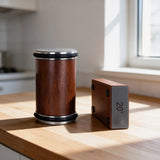
A magnetic block holds the knife at 15° or 20°. You roll the disc along the edge.
400 grit diamond on one end of the roller, 3000 grit ceramic on the other.
See the sharpener