Fixing a dull knife
Can you over-sharpen a knife?
No knife gets too sharp. The concern is that every sharpening removes a little steel — and coarse abrasives remove it fastest.
By Rollkeen, which sells a rolling knife sharpener Published
No knife gets too sharp
You cannot sharpen a kitchen knife to a point where it becomes a problem. Every sharpening grinds steel away to form a new bevel, and each session takes a small amount off the blade. Over years of regular sharpening, the knife is a little narrower from spine to edge than when it was new.
What people mean when they worry about over-sharpening is usually one of two things: using the coarse stage when the edge did not need it, or sharpening more often than the blade requires. Neither makes the knife too sharp — both thin it faster than necessary.
The question worth asking is not whether the knife is sharp enough, but whether this session needed the coarse side at all.
What removes metal fastest, and what barely does
How much steel comes off per session depends almost entirely on which grit you use. About 400 grit removes steel fastest and is for chips, very dull edges and reshaping; about 3000 grit refines and polishes the edge the coarser grit left.
| Grit stage | What it does to the edge | When to use it |
|---|---|---|
| Coarse (about 400) | Grinds a fresh bevel from scratch; removes the most steel per pass | Very dull, or chipped |
| Fine (about 3000) | Polishes the bevel already there; takes off almost none | Slightly dull; regular touch-ups |
The same knife ground on the coarse side every week loses more height in a year than a knife touched up on the fine side when it needs it. The coarse stage is what accumulates. What happens to the sharpener's own discs and stones over time is a separate question, covered in whether knife sharpeners wear out.
How many times can you sharpen a knife?
Many. A well-made kitchen knife holds up to many sharpenings when each session is light. Shun's advice to its own owners is not to sharpen weekly, because frequent sharpening shortens the knife's life: not from sharpness itself, but from the repeated removal of steel.
What gives you a reference point is the knife's own heel. Each session removes a thin layer. Over years, the belly and tip, where most of the grinding happens, lose height while the heel barely changes. On a knife with a full bolster, the last bit of edge at the heel is hard to reach during sharpening, so it stays near its original height the longest. Comparing the spine-to-edge distance at the heel with the distance further toward the tip gives you a rough picture of the cumulative loss.
Knives that get dull faster, from glass, stone and metal cutting surfaces, or storage where the edge knocks against other metal, need deeper grinding each time they are sharpened. That removes more steel per session. A knife kept on a wood board, hand-washed and stored with its edge clear, stays sharper between sessions and needs only a light pass to restore it.
If the knife is only a little tired, the fine side is enough
When a knife is only slightly dull, pushing a little against a tomato skin rather than gliding through, start on the fine side. Polishing on the 3000 grit ceramic side alone takes off almost no steel, so this is the touch-up that spares the blade.
Reserve the 400 grit for a knife that has actually gone flat. Reaching for the coarse end out of habit, on a blade that only needed polishing, removes more steel than the edge required — and that is the nearest thing to over-sharpening that a home cook encounters.
Advice on how often kitchen knives need sharpening varies considerably: from once or twice a month to once or twice a year, depending on the source and the cook. What matters for how much steel a knife loses is not the interval alone, but the depth of each session: a light fine-side touch-up every two weeks removes far less than a coarse grind every few months.
Do knife sharpeners damage a knife?
Not on their own — but a sharpener used at the wrong stage takes more steel than the edge needs. The concern is not sharpeners as a category; it is reaching for a coarse stage on a blade that only needed polishing.
Among common sharpener types, carbide pull-through slots can remove more steel than the edge needs and may leave a rough edge. For what each type does to your knife's bevel over time, see whether pull-through sharpeners are bad for knives.
A rolling sharpener with a fixed-angle block gives the same edge angle on every pass, so there is no grinding of an unintended second bevel. What controls the steel removed is how often you use the coarse side, and whether the edge actually needed it. The full sequence, including when to stop each stage and how to test the result, is in how to use a rolling knife sharpener.
Sources

Rollkeen rolling knife sharpener
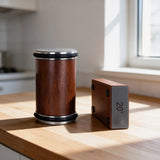
A magnetic block holds the knife at 15° or 20°. You roll the disc along the edge.
400 grit diamond on one end of the roller, 3000 grit ceramic on the other.
See the sharpener