Fixing a dull knife
Why do knives get dull?
An edge gets dull in two ways: the steel at its tip wears down from friction, and it bends or chips when it hits something hard. Hard cutting surfaces, the dishwasher and loose storage all speed that up.
By Rollkeen, which sells a rolling knife sharpener Published
The short answer
An edge is a strip of steel thin enough to cut. At that thinness, two things happen with every use: friction from the food gradually wears the tip flat, and hard contact from a stone cutting board, a ceramic plate or another blade rattling in the drawer bends or chips it. Both leave the knife dull, and neither fixes itself without grinding.
Wear and deformation: the two things that happen to an edge
A sharp edge is a V of steel tapered to a fine point. That point is thin enough to slide through food rather than push it aside — but it is also thin enough that nothing keeps it there indefinitely.
Friction wears it flat. Each cut rubs the edge against whatever it is cutting. Over enough cuts the tip rounds over until it no longer comes to a point and the knife pushes instead of parts. This happens on any cutting surface; it only goes faster on harder ones.
Hard contact bends or chips it. When the edge meets something harder than itself, such as a glass board, a stoneware plate, a granite countertop, or another blade, the thin steel yields. Knife Steel Nerds, reviewing the metallurgy research on edge stability, notes that a thinner, more acute edge has less steel behind it and needs less force to roll or chip. A wider edge is stronger against bending.
What dulls a knife faster than normal use
Every use wears an edge, but several habits speed that up considerably.
| Factor | What it does to the edge | Source |
|---|---|---|
| Every cut | Impact and friction gradually wear and bend the tip. The thinner the edge, the sooner either happens. | Knife Steel Nerds on edge stability |
| Glass, stone, ceramic or metal cutting surfaces | These surfaces are harder than the knife's steel, so the edge wears or bends faster on every stroke. | Henckels; America's Test Kitchen on glass boards; Messermeister |
| Machine washing | Blades knock against other items in the dishwasher and get nicked. Heat and detergent can attack the steel and handle over time. | Henckels; Zwilling |
| Loose storage in a drawer | Blades rub against each other and get dulled or chipped — even when no one is using them. | Victorinox; Shun |
The cutting surface has the biggest effect. A glass board dulls an edge so fast that America's Test Kitchen uses one on purpose when it needs blunt knives for a test. Its 2026 test of metal cutting boards found knives dulled sharply with every use on metal, while the same knife on a wooden board stayed near new. Makers disagree about bamboo.
What a honing steel does and doesn't fix
A honing steel tunes up the very edge between sharpenings. Use it regularly and it delays the moment when grinding is needed. Honing maintains an edge but cannot rebuild one. Once the steel has worn or bent past what a steel can fix, the knife needs grinding.
Shun and Victorinox both say that when honing no longer brings the edge back, the knife needs sharpening. Zwilling says the edge must then be reground.
What a steel does to the metal on that timescale is contested. America's Test Kitchen, examining honed knives under a microscope at an MIT materials lab, found that "even the smoothest rod still removes metal." Science of Sharp's electron-microscope series concluded that most dulling happens by wear and blunting rather than rolling over, and that steeling tends to leave a micro-bevel. So "a steel only realigns the edge" is not the full picture, and "a steel removes no metal" is not accurate either. The practical point is the same: when the edge has worn flat or bent enough to need grinding, honing alone will not fix it.
How to keep an edge sharp longer
- Use a wood or plastic cutting board. Victorinox recommends a wood or plastic board and says cutting on natural or artificial stone dulls the edge quickly. Either is far easier on a knife than glass, stone, ceramic or metal.
- Hand-wash and dry immediately. Victorinox says hand-washing helps knives stay sharp longer. Wash by hand and dry straight away before putting the knife away.
- Store each knife separately. Victorinox and Shun both say blades kept loose in a drawer dull against each other between uses, and recommend keeping each knife separate — in a block, an in-drawer tray, a blade guard or on a magnetic bar.
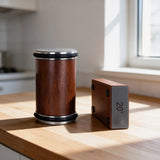
Even with good habits, the edge will need sharpening eventually. Rollkeen's rolling sharpener grinds a fresh edge at 15° or 20° without having to hold the angle yourself. The magnet does that. For a broader look at how the sharpener itself changes with use, whether knife sharpeners wear out covers what changes in each type and how to tell. If you are weighing which sharpening method to use, whether pull-through sharpeners are bad for knives goes into what each slot type does to the edge and what ten knife makers say about it.
Sources
- Knife Steel Nerds: what is edge stability?
- Henckels: use and care
- America's Test Kitchen: why you shouldn't use a glass cutting board
- America's Test Kitchen: metal cutting boards review
- Messermeister: cutting surfaces for knives
- Victorinox: knife care tips
- Victorinox: how to sharpen your kitchen knife
- Shun: frequently asked questions
- Zwilling: knife sharpening, use and care
- America's Test Kitchen: honing rods review
- Science of Sharp: what does steeling do?

Rollkeen rolling knife sharpener
A magnetic block holds the knife at 15° or 20°. You roll the disc along the edge.
400 grit diamond on one end of the roller, 3000 grit ceramic on the other.
See the sharpener