Choosing a tool
How much does knife sharpening cost?
Professional sharpening is priced per knife or per inch of blade, with rates that vary by service and location. For most kitchen knives, sharpening at home costs less over time — but serrated edges, ceramic blades, and single-bevel Japanese knives usually need more than a standard home sharpener.
By Rollkeen, which sells a rolling knife sharpener Published
Professional sharpening is priced per knife or per inch of blade
Most sharpening services use one of two models: a flat fee per knife, or a rate per inch of blade length. Mail-in services tend to charge per knife; local sharpeners, culinary stores, and vendors at farmers' markets more often charge by the inch, usually with a minimum. Rates vary enough by region and service type that checking a service's own price page or calling ahead is the only way to know what you will pay.
| Service | Rate (USD) | Model |
|---|---|---|
| Sur La Table | 8 | Per knife, in-store |
| Sharp Knife Shop | 10–20 | Per knife by length |
| Chubo Knives | 14 | Per knife (Western) |
| MAC (own knives) | 8–12 | Per knife by length |
| MAC (other brands) | 15–25 | Per knife by length |
| Misen | 69–154 | Mail-in package, 5–14 knives |
| Dalstrong | 69–89 | Mail-in package, 5–7 knives |
| Zwilling / Knife Aid | 59–119 | Mail-in package, 4–10 knives |
| Korin | 25 | Per knife (Western) |
| Bernal Cutlery | From 1.75 | Per inch |
| Cutco | Free + USD 11 return fee (1–5 knives) | Mail-in, Cutco knives only |
What moves the price up:
- Chips and damage. A chipped edge means grinding back past the chip before forming a new bevel — more steel removed, more time, and usually a surcharge.
- Blade length. Under a per-inch model, a 10-inch slicing knife costs proportionally more than a 6-inch utility knife.
- Special grinds. Single-bevel knives, asymmetric grinds, and blades at an unusual angle take more care and usually carry an extra charge.
Some knife makers offer professional sharpening directly. Victorinox offers professional sharpening in its stores; Shun takes its knives back for sharpening, calling it the easiest way to be sure they are sharpened correctly.
What a year of sharpening costs for a typical household
Annual service cost has three parts: how many knives you send out, how often you send them, and the per-knife or per-inch rate. Multiply them and you have the year's total. A household with four workhorse knives sharpened once a year pays for four sharpenings; twice a year, eight. At Sur La Table's rate of USD 8 per knife, four knives twice a year comes to USD 64. At Zwilling's four-knife mail-in package (USD 59 a package), the same two annual visits cost USD 118.
The factor that changes annual cost fastest is frequency. How often knives need sharpening depends on what you cut, what surface you use, and whether you hone between sessions. A regular honing routine can stretch the interval. The guide on how often to sharpen kitchen knives covers what different makers recommend and what honing adds or cannot replace.
When several knives need a service two or three times a year, the year's total can exceed what a home sharpener costs once. The break-even point is wherever the home sharpener's purchase price equals what service visits would cost over the same span. How fast that arrives depends on the service's rate and your visit count.
Serrated edges, ceramic blades, and single-bevel Japanese knives usually need more than a standard sharpener
For these categories, a standard home sharpener is not enough on its own. Most need a service or a specialist tool, not a standard home sharpener.
| Knife type | Service or sharpen at home? |
|---|---|
| Serrated edges | Service. |
| Ceramic blades | Service with a diamond wheel, or a home diamond-wheel sharpener made for ceramic. |
| Single-bevel and asymmetric Japanese knives | Whetstone in practiced hands, or a specialist with Japanese-knife experience. |
| Badly chipped blades | Service first (belt grinder or powered wheel); standard maintenance at home after. |
| Most steel kitchen knives | Home sharpener or service — your choice. |
Serrated knives are the most common case. Zwilling advises having serrated knives professionally sharpened or replaced; Victorinox recommends a professional service for all wavy-edge blades. Some proprietary patterns go further: Cutco instructs owners not to sharpen its Double-D edges with any sharpener or service, and to return them to the factory.
Ceramic blades are a material question, not a technique one. Kyocera directs ceramic knife owners to a diamond-wheel sharpening service or to its own battery-powered diamond sharpener. Standard abrasives and rolling sharpeners won't cut zirconia.
Single-bevel and asymmetric Japanese knives are the case most home cooks underestimate. Masamoto describes its sashimi, deba and usuba blades as single-edged; Korin says many Japanese Western-style knives are sharpened unevenly, often in a 70:30 ratio. Using a fixed-angle sharpener on both sides converts one of these to a symmetric bevel, which changes how it cuts. For these blades, a whetstone in practiced hands or a specialist is the only way to maintain the existing grind.
What sharpening at home costs instead
A home sharpener handles most kitchen knives: chef's knives, santokus, German and Western knives, utility and carving knives. For those knives, it replaces repeated service visits. The difference from a service is the payment structure: one upfront cost rather than a fee per use.
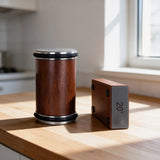
Rollkeen's rolling sharpener holds the blade at 15° or 20° using a magnet, so there is nothing to hold steady by hand. The 400 grit diamond end sharpens; the 3000 grit ceramic end polishes. For a knife used daily, that takes a few minutes about every two weeks. The guide on which knives fit a rolling sharpener lists exactly what it handles and what it does not.
A whetstone costs less to buy and gives full control over the angle — you choose it, hold it, and grind to whatever finish the stone allows. The trade-off is practice: a hand drifts without you noticing, and an uneven bevel means reworking the edge later. Whether a whetstone is worth buying depends on whether you want to build that skill.
For the knives it does handle, the break-even is straightforward: a home sharpener whose purchase price falls below your annual service total pays for itself in a year.
Sources
- Victorinox: how to sharpen your kitchen knife
- Zwilling: knife sharpening, use and care
- Shun: sharpening vs honing
- Cutco: knife care, sharpening and repair
- Masamoto Sohonten: Japanese knives, single-edged and double-edged
- Korin: about Western-style knives
- Kyocera: ceramic knife FAQ
- Sur La Table: knife sharpening
- Cutco: sharpening service
- Cutco: return and repair
- Zwilling: sharpening service by Knife Aid
- Misen: knife sharpening
- Dalstrong: knife sharpening service
- MAC Knife: FAQs (sharpening rates)
- Bernal Cutlery: sharpening services
- Korin: sharpening service
- Sharp Knife Shop: sharpening service
- Chubo Knives: knife sharpening service

Rollkeen rolling knife sharpener
A magnetic block holds the knife at 15° or 20°. You roll the disc along the edge.
400 grit diamond on one end of the roller, 3000 grit ceramic on the other.
See the sharpener