Angles
What angle are Wüsthof knives sharpened at?
About 14° per side for standard blades, 10° for santokus and nakiris — here is what each figure means on a 15°/20° block.
By Rollkeen, which sells a rolling knife sharpener Published
The short answer
Standard Wüsthof blades leave the factory at about 14° per side. Asian-style blades (the santoku, nakiri, and similar flat-edged lines) are ground at about 10° per side. Wüsthof gives both angles in its FAQ.
Neither angle lands on the 15° or 20° faces of a standard two-angle block. The 15° face is the closer fit for all Wüsthof lines; the 10° Asian-style knives land 5° below even the nearer face.
Wüsthof's two stated angles
| Blade type | Factory angle (per side) | Total included angle |
|---|---|---|
| Standard blades | about 14° | about 28° |
| Asian-style blades (santoku, nakiri) | about 10° | about 20° |
A common rule of thumb puts German knives at 20° per side. Wüsthof's own FAQ now gives about 14°. If you have a Wüsthof, use their figure rather than the general rule.
Using a 15°/20° block on Wüsthof knives
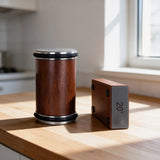
On the Rollkeen sharpener, a magnetic block holds the knife at 15° on one face and 20° on the other. Each face sits a different distance from Wüsthof's stated angles.
| Blade type | Factory angle | Gap on 15° face | Gap on 20° face |
|---|---|---|---|
| Standard | about 14° per side | +1°: narrow micro-bevel at the edge | +6°: larger bevel shift |
| Asian-style | about 10° per side | +5°: significant bevel change | +10°: major bevel change |
For standard Wüsthof blades, the 15° face sits about 1° wider than the factory bevel. Each pass puts a narrow micro-bevel at the very edge. The first session resets the shoulder to the face angle; subsequent sessions are faster because the bevel is already close.
Using the 20° face on a standard Wüsthof adds 6° to the bevel — a larger regrind that removes more metal and produces a noticeably wider final edge.
For Asian-style Wüsthof blades, neither face is close to the factory 10°. The 15° end is the smaller compromise: the bevel shifts from 10° toward 15°, adding 5° per side, which widens the edge and increases the wedging force on each cut. If you use the block on these blades, use the 15° face; the edge will wedge more than a fresh factory 10° and will dull at the wider angle going forward.
Classic line knives and the full bolster
The Wüsthof Classic line has a full bolster — a thick metal collar between blade and handle that extends down toward the edge. When sharpening on the block, the bolster contacts the face before the edge near the heel makes full contact, leaving the last portion of that edge with lighter abrasive pressure on each pass.
The rest of the blade sharpens normally. The heel zone takes more passes to reach a consistent edge; give the last inch extra passes, or run a tapered honing rod over that stretch to reach what the flat disc cannot.
Not sure of your edge's current angle?
If a Wüsthof knife has been professionally resharpened or has seen heavy use, its bevel may no longer be at the factory angle. The marker test reveals the existing bevel angle before you commit to a face — it takes under a minute and needs only a felt-tip marker.
Once a knife is on one face, moving to the other means grinding away the existing bevel shoulder from scratch. What each direction costs in steel and passes, and when a switch is worth doing, depends on the gap between the two angles.
Sources

Rollkeen rolling knife sharpener
A magnetic block holds the knife at 15° or 20°. You roll the disc along the edge.
400 grit diamond on one end of the roller, 3000 grit ceramic on the other.
See the sharpener