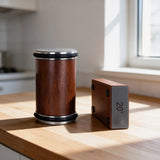
Rolling sharpeners
Why is my rolling knife sharpener not sharpening?
The usual cause is stopping before the edge is formed, or the edge not reaching the disc. Work through these six checks in order.
By Rollkeen, which sells a rolling knife sharpener Published
The two most common causes
A rolling knife sharpener that feels like it is doing nothing is usually running into one of two problems. Either the edge has not yet fully formed (the knife has not had enough passes on the coarse disc for the burr to appear), or the cutting edge is not making contact with the disc at all. Both produce the same result: the knife comes out no sharper than it went in.
The six checks below are ordered by how often each cause comes up. Work through them in sequence, starting at the top.
Six checks, in order of likelihood
- Not enough passes: the burr has not formed yet. The coarse disc grinds one side of the edge at a time; the burr (a faint lip of steel) forms on the opposite side once grinding has gone right through to the edge. That burr is the signal the edge has been reached. Without it, the knife is not ready for the fine disc and will still be blunt. 20-second check: after several passes on the coarse disc, rest your thumb flat across the blade on the side opposite the one you last sharpened, then drag slowly toward where the edge is. A faint catch or roughness means a burr is forming. No sensation at all: keep going on the coarse disc.
- The edge is not making contact with the disc. The blade must sit so the cutting edge, not the spine, the magnet, or the housing, touches the abrasive disc. Three situations break that contact. (a) The tip: the tip sits past the end of the magnet, where the blade is no longer held flat; raise the handle a little over that final inch so the edge stays against the disc. (b) Narrow blades: the edge must clear the top of the block for the disc to reach it; on a narrow blade, confirm the edge stands above the block before rolling. (c) Tall blades: a blade taller than the housing can ride on the housing rather than the disc. 20-second check: watch from eye-level as you make one slow pass. The cutting edge should visibly press against the disc along its full length.
- Using the fine disc when the coarse disc is needed first. The fine ceramic disc (3,000 grit) polishes and refines an edge that already exists. It cannot build a bevel from scratch. If the knife is very dull, or if it was last sharpened at a different angle, the 400-grit diamond disc must come first. 20-second check: look at which side of the sharpener you have been using. The coarse disc feels distinctly rougher to the fingertip. If the edge is not responding on the fine side, the coarse disc is needed first.
- The bevel angle changed since the last session. If the blade was previously sharpened at a different angle (say, 20° and now the 15° block is fitted, or the reverse), the disc meets the shoulder of the old bevel rather than the cutting edge. The old bevel has to be reground before a new edge can form, which takes more passes than a routine touch-up. 20-second check: color the full edge on both sides with a felt-tip pen. After a few passes on the coarse disc, check where the ink has been removed. Ink remaining along the edge shows the disc has not reached it yet.
- The roller is stiff. Dust in the wheel bearing, or dry air causing the wood of the roller to shrink onto the shaft, can make the roller drag instead of turning freely. When the roller does not spin, the blade slides across the disc rather than rolling, reducing contact and cutting action. 20-second check: flick the roller with a fingertip. It should spin freely for a moment. If it barely turns, wipe the axle area with a dry cloth.
- The coarse disc is worn. Diamond-coated abrasives wear with use, and the coarse disc wears faster when grinding very dull knives or harder steels. A worn disc removes steel slowly, so many extra passes produce little result. 20-second check: if the coarse disc is taking far more passes than usual to raise a burr, and nothing else has changed, wear is a likely cause. How abrasives age over time is covered in the guide on sharpener wear.
How to tell the edge has fully formed
The burr is the most reliable sign that the coarse disc has reached the cutting edge. When enough steel has been ground away, the last fraction of a millimeter bends away from the abrasive and folds onto the opposite face. That fold is what you catch when you drag a thumb across the spine side after sharpening.
Test at three points along the blade: near the handle, halfway, and at the tip. A burr can form along part of the blade but not the rest, leaving a mixed result of sharp and dull sections. When you feel a consistent, slight catch along the full length from the opposite side, the coarse-disc stage is complete.
One complication: some burrs stand straight up and cannot be felt at all. And once you turn the knife over, any lip you feel on the second side can be the first burr folded over rather than a fresh one. The marker method is the more reliable confirmation — color the edge on both sides with a felt-tip pen, run several passes, and check whether the ink has been ground off both sides evenly. The full sequence for checking and completing an edge is in the step-by-step sharpening guide.
Why the first sharpen takes longest
A knife sharpened for the first time on a rolling sharpener, or one that has not been maintained for a long period, requires the coarse disc to grind the entire bevel to the chosen angle before any edge forms. That is more steel to remove than a routine touch-up, and it takes proportionally longer.
Once the bevel is established at the correct angle, every future session starts from a much closer point. Rollkeen's own guidance puts routine maintenance at a few minutes every couple of weeks for a knife used daily, with the first full sharpen taking the longest single session. If a knife is taking far longer than expected and is not responding, run through the six checks above before assuming the sharpener has a fault.
What a rolling sharpener is not designed to fix
A few situations fall outside what a rolling wheel sharpener handles well:
- Serrated edges. The disc cannot follow individual scallops. Serrated edges are not a job for a rolling sharpener; knife makers say they need professional sharpening or a specialist tool.
- Large chips or a broken tip. A chip removes a section of edge entirely. A rolling sharpener will grind past a small chip over many passes, shortening the blade in the process. A very large chip or broken tip is faster to address with a coarser abrasive before returning to the rolling sharpener for finishing.
- A blade that sharpens but stays dull in use. If the sharpener does form an edge but it dulls quickly, the problem is not the sharpener failing — it is the edge not holding. Steps for diagnosing a blade that dulls quickly are in why a knife is still dull after sharpening.
Sources

Rollkeen rolling knife sharpener
A magnetic block holds the knife at 15° or 20°. You roll the disc along the edge.
400 grit diamond on one end of the roller, 3000 grit ceramic on the other.
See the sharpener