Choosing a tool
Knife sharpener vs whetstone
A whetstone gives the most control and asks for the most skill. Pull-through, electric and rolling sharpeners each trade some of that control for an angle the tool sets for you.
By Rollkeen, which sells a rolling knife sharpener Published
Which is better: a knife sharpener or a whetstone?
Neither is better for every cook. A whetstone gives the most control and asks for the most skill; every type of sharpener trades some of that control for an angle the tool sets for you. The right choice is whichever fits the knives you own and how much of the work you want to handle yourself.
Three kinds of sharpener hold the angle differently. A pull-through draws the blade through a V of abrasives; an electric machine uses a motor to turn the abrasive against the edge; a rolling sharpener sets the knife at a fixed angle on a magnetic block; a disc on a cylinder runs along the edge, one side at a time. All three remove steel and leave an edge. All three lose something a skilled pair of hands on a stone can still do.
What all three sharpener types give you, and what they give up
Each type sets the angle differently, and each gives up something the stone keeps. The table below shows what each holds for you and what it leaves to you.
| Tool | How the angle is set | Main limits | What you still have to do |
|---|---|---|---|
| Pull-through | A V-shaped slot at a preset angle, usually 15° or 20°. | Only the slot's angle. Cannot grind out a chip. Serrated knives need a specialist. | Draw from heel to tip without tilting the blade. Keep the pressure light. |
| Electric | The machine's stages and a preset angle. Most are built for one angle class: 15° or 20°. | Only the machine's built-in angles. Serrated edges may have a stage designed for them, if the machine includes one. | Steady pull, light pressure, burr check. The machine holds the angle; its instructions still ask for care on every pass. |
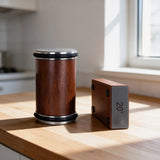
| Rolling sharpener | A diamond or ceramic disc rolls along the blade's edge while a magnetic block keeps the knife at a set angle. | Only the angles on the block. Not for serrated edges, ceramic blades, short knives, or blades a magnet will not hold: see which steels are and are not magnetic. | Which end of the block to use. How to reach the tip and, on some knives, the heel. |
| Whetstone | Your hands, on every stroke, on both sides of the blade. | Serrated edges. Kyocera specifies a diamond wheel for sharpening its ceramic blades. | To maintain a consistent angle through every stroke, on both sides, and to judge when the new bevel meets the edge. |
Grit numbers on a disc and grit numbers on a stone do not compare directly. The same number means different particle sizes on different grading scales: Europe's abrasives body keeps one scale for bonded abrasives and separate ones for coated abrasives and diamond. A conversion table from one specialist retailer shows a 400-grit bonded abrasive at roughly 17 microns, while the same number on a 1973 Japanese scale sits near 40 — more than double; that gap makes cross-tool grit comparisons unreliable.
What a pull-through trades against a whetstone
Speed is the main gain. You draw the knife through the slot once or a few times and you have a sharper edge. What the slot cannot do is grind out a chip, or give the knife a narrower angle than the slot was built for. And the abrasive matters: carbide types can take off more steel than the edge needs. A diamond pull-through was America's Test Kitchen's favorite manual sharpener in a 2025 test of the category.
Knife makers disagree on pull-throughs for hard Japanese blades. Tojiro says a simple sharpener can be used on its knives but restores sharpness only for a while and is recommended for everyday upkeep between whetstone or professional sharpenings. Yoshihiro's sharpening guide covers whetstone technique and does not address pull-through sharpeners. Shun sells a pull-through matched to its own knives.
For a full account of what each slot type does to an edge, and what ten knife makers say, see whether pull-through sharpeners are bad for knives.
What an electric sharpener trades against a whetstone
An electric sharpener drives the abrasive with a motor as you draw the knife through its guides. The angle comes from the machine's stages, most built for a 15° class or a 20°: the first sharpening regrinds the edge to the machine's own angle, whatever the maker ground on the knife before.
The machine sets the angle; its instructions still ask for a steady pull, light pressure and a burr check at the end. What it cannot give you is any angle beyond its built-in stages, a finish beyond its finest, or a reliable method for a knife ground unevenly or on one side only. For those, a whetstone or a shop that specialises in Japanese knives is what most knife makers point to.
For a comparison of an electric sharpener against a rolling sharpener, with notes on which type suits which job, see how the two differ, and when each is the better buy.
What a whetstone does that a sharpener cannot
- Any angle. Every sharpener gives you the angles its slot or block was built for. A stone imposes no angle: you grind at whatever the knife requires, and each side is held independently.
- Knives ground unevenly, or on one side only. In America's Test Kitchen's gyuto review, more than half of the eleven knives tested carried uneven grinds, with bevels at different ratios on each side, and the review warned against levelling them. A fixed-angle tool used on both sides of such a knife makes them the same, changing the balance the maker ground in. A whetstone, in experienced hands, can follow the maker's grind.
- Short knives. Paring, steak and pocket knives are too short to reach the disc on most rolling sharpeners, and a fixed slot grinds only what it reaches. No blade length is too short for a stone.
- Beyond the finest disc. Yoshihiro's sharpening guide works through 400, 1000 and up to 10000 grit, each step refining what the last left. Each sharpener type stops at its finest abrasive. In skilled hands, a whetstone with very fine grits can go further.
- Chip repairs. Yoshihiro's guide assigns chips and repairs to a coarse (400 grit) stone, which it says reshapes blades and fixes chips. A pull-through or a rolling sharpener's disc reaches only the edge's bevel.
Which tool fits your situation?
Choose a whetstone if
- you want to choose the angle yourself, or keep a maker's angle that no sharpener matches;
- you own knives ground unevenly or on one side, or hard Japanese knives whose makers say to use a stone;
- you sharpen paring, steak or pocket knives as well as full-size kitchen knives;
- you will keep at it until your hands hold an angle through every stroke.
Choose a sharpener if
- you want your kitchen knives sharp and have no interest in learning to sharpen as a skill;
- your knives have smooth edges that fit the tool's angles — 15° and 20° cover most full-size kitchen knives used daily;
- a quick session every couple of weeks is what your schedule allows.
Between the three sharpener types: a pull-through draws the blade through a V of abrasives; an electric machine uses a motor to turn the abrasive against the edge; a rolling sharpener holds the knife still on a magnetic block and grinds one side at a time. Rollkeen's rolling sharpener carries a 400 grit diamond disc to sharpen and a 3000 grit ceramic disc to polish, at 15° or 20°. In skilled hands a whetstone with very fine grits can go further.
To go deeper on any of these pairs: a rolling sharpener against a whetstone, with what each can and cannot do; what a whetstone asks you to buy, learn and keep up; whether pull-through sharpeners are bad for knives, and what ten makers say; how a rolling sharpener and an electric compare, and when each is the better buy.
Sources
- America's Test Kitchen: best manual knife sharpeners (published 2025-07-09)
- Sharpening Supplies: pros and cons of pull-through sharpeners
- Tojiro: store FAQ (in Japanese)
- Yoshihiro: how to sharpen your knife
- FEPA: abrasive standards
- Fine Tools: comparison of abrasive grain sizes
- Zwilling: knife sharpening, use and care
- America's Test Kitchen: best gyuto (published 2025-12-17)
- Kyocera: ceramic cutlery FAQ

Rollkeen rolling knife sharpener
A magnetic block holds the knife at 15° or 20°. You roll the disc along the edge.
400 grit diamond on one end of the roller, 3000 grit ceramic on the other.
See the sharpener