Choosing a tool
How to sharpen a knife without a whetstone
Four options actually work: a sharpening service, a pull-through sharpener, an electric sharpener, or a rolling sharpener. A honing steel is not one of them — it maintains an edge between sharpenings but cannot grind a new bevel on a knife that has gone dull.
By Rollkeen, which sells a rolling knife sharpener Published
Honing is not sharpening
Honing is upkeep for an edge that is still mostly there — once the edge has worn flat, only sharpening can rebuild it. Shun puts the difference plainly: sharpening removes steel to form a new edge; honing is light maintenance done between sharpenings. Wüsthof, Zwilling, and Victorinox say the same. When honing no longer brings the edge back, the knife needs sharpening.
Pull-through sharpeners: set it and pull
You draw the knife through a V-shaped slot while the sharpener sits on the counter. The slot sets the angle; the abrasive inside grinds both sides of the edge in one pull. Speed is the main advantage.
What is in the slot matters. Carbide abrasives tend to grind more than the edge requires, leaving it rough. In America's Test Kitchen's 2025 test, diamond came out ahead. Ceramic sits between the two.
Not all knives are a good match. Yoshihiro advises against anything but a whetstone for its hard Japanese blades, citing the risk of damage to hard steel. Tojiro says a simple sharpener restores sharpness only for a while and recommends using one only for everyday upkeep between whetstone sessions. Most models have one fixed angle, so a knife ground at a different angle gets reground to the slot's angle the first time, which takes more passes and more steel.
Pull-through sharpeners: good or bad for knives examines what each slot type does to an edge and what knife makers say about using them.
Electric sharpeners: motor-driven, fastest per knife
An electric sharpener holds the angle through guide slots or spring-loaded arms while a motor turns the abrasive. You draw the knife through, usually in a stage or two, and the machine does the grinding. Because the powered abrasive works through a dull edge quickly, an electric sharpener handles a fully dull or chipped knife faster than a hand-held tool — and the tradeoff is that it removes more from each session, so it is less suited to routine touch-ups than to knives that are genuinely dull.
The machine's built-in angle determines what bevel your knife gets, so the same angle-matching consideration as with a pull-through applies: check whether it matches your knife before buying. Paring knives and steak knives that a rolling sharpener cannot reach go to a pull-through or an electric sharpener instead.
Rolling sharpeners: flat disc, two angles on one block
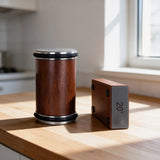
A rolling sharpener uses a magnetic block to hold the knife at a set angle, edge up, while you roll a disc along the blade. You sharpen one side of the edge, turn the knife, sharpen the other, then switch to the fine disc to polish. The angle is in the block, not in your hands.
Rollkeen's rolling sharpener has a 15° end and a 20° end on the same block: 15° for Japanese knives and thin blades, 20° for German and Western knives. The roller has two discs: 400 grit diamond on one end, 3000 grit ceramic on the other. If the knife is only slightly dull, start on the ceramic side: it takes off almost no steel. For a knife you use daily, a touch-up takes a few minutes; the first sharpen takes longest because the disc resets the edge to the block's angle before it can polish anything.
To see how the two most common tool types compare side by side, rolling sharpener vs pull-through sharpener draws both methods and walks through the differences.
Which option fits your situation
| Situation | Good fit | The catch |
|---|---|---|
| Want sharp knives, nothing to learn | Pull-through (diamond type) or rolling sharpener | Pull-throughs are faster. Rolling sharpeners give two angle choices and a finer finish. |
| Many knives to sharpen at once | Electric sharpener | Check the machine's angle against your knife before buying. |
| Short knives: paring, steak, pocket | Pull-through or electric | Rolling sharpeners need enough blade length to reach the disc. |
| Serrated or chipped edge | Sharpening service | No home sharpener reaches inside a serration or grinds back a deep chip. |
| Maker says to use a whetstone | Sharpening service | Some Japanese knife makers advise against fixed-angle home sharpeners for their hard steel. |
| Sharpen once or twice a year | Sharpening service | Nothing to buy, store, or learn. |
Some home cooks reach for an unglazed mug base, sandpaper, or a concrete step when no tool is at hand. None sets the angle: that part is in your hands, the same as on a whetstone, and the result varies. Any of the tools in the table sets it for you.
Sources
- Wüsthof: how to sharpen your Wüsthof knives
- Zwilling: knife sharpening, use and care
- Shun: sharpening vs honing
- Shun: frequently asked questions
- Victorinox: how to sharpen your kitchen knife
- America's Test Kitchen: review of manual knife sharpeners
- Sharpening Supplies: pros and cons of pull-through sharpeners
- Tojiro: frequently asked questions (in Japanese)
- Yoshihiro: frequently asked questions
- America's Test Kitchen: review of gyuto knives

Rollkeen rolling knife sharpener
A magnetic block holds the knife at 15° or 20°. You roll the disc along the edge.
400 grit diamond on one end of the roller, 3000 grit ceramic on the other.
See the sharpener