Fixing a dull knife
How to sharpen a cleaver
A meat cleaver takes a wide, sturdy angle to protect the edge against bone; a Chinese vegetable cleaver takes a fine one. Which you own changes both the end of the sharpening block and what to expect from the first sharpen.
By Rollkeen, which sells a rolling knife sharpener Published
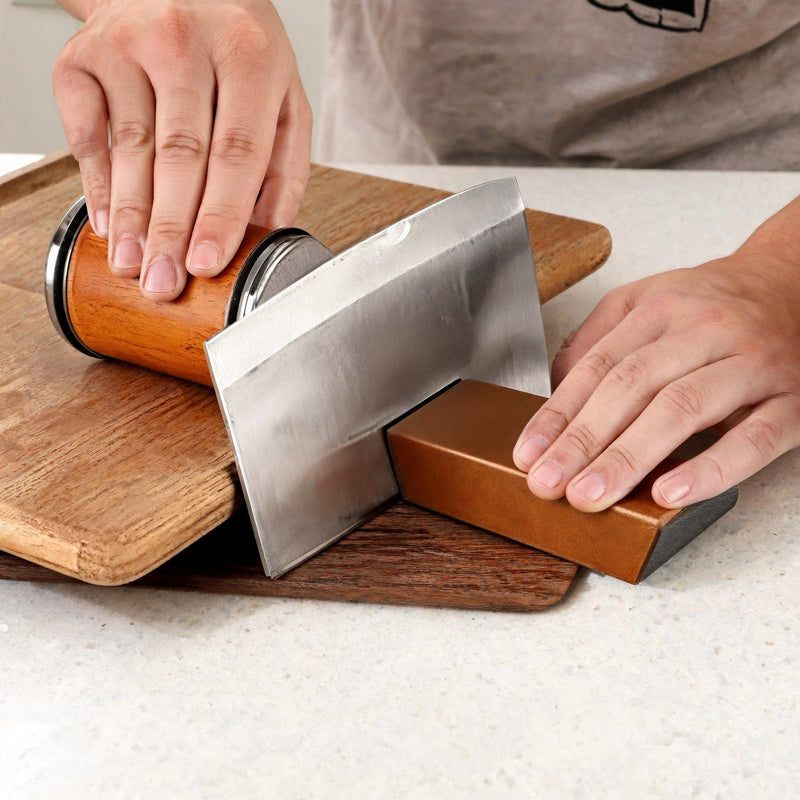
A meat cleaver and a Chinese vegetable cleaver are sharpened differently
A meat cleaver is built for splitting through joints and bone. The edge is wide and sturdy, ground at an angle designed to resist chipping against hard material. A Chinese vegetable cleaver, sometimes called a cai dao, is built for precision: julienning and thin-slicing where the edge needs to stay fine.
The quickest way to tell which you have is the spine. A meat cleaver's spine is thick enough to feel substantial, and the blade is built to take a palm strike on the spine. A Chinese vegetable cleaver's spine is thinner, the blade is lighter, and that kind of force would damage it.
Both types are tall enough that sharpening them on a rolling sharpener takes a cutting board beside the block to raise the roller. For the full list of knives a rolling sharpener can and cannot take, see which knives fit a rolling knife sharpener.
Cleaver edge angles from 15 to 30 degrees
America's Test Kitchen's April 2026 cleaver review covered eleven Western-style meat cleavers and found edge angles from 15° to 30° per side — wider than the same makers' chef's knives. The review notes that Western-style cleavers have historically been given angles of 20° or more to protect the edge against chipping on bone. Kai's FAQ states 16° per side for its PRO cutlery, including its cleaver. Global gives a range of 10–15° for all its knives; the review lists its G-12 meat cleaver at 15°.
| Cleaver | Angle (per side) | Block end |
|---|---|---|
| Wüsthof Grand Prix II 6-inch | 30° | 20° end (reground narrower at either face) |
| KitchenAid Classic Forged 6-inch | 22° | 20° end |
| Dexter Russell S5387 7-inch | 20° | 20° end |
| Lamson 7.25-inch Walnut Handle | 20° | 20° end |
| Mercer Culinary 7-inch Kitchen | 20° | 20° end |
| Messermeister Park Plaza 7-inch | 20° | 20° end |
| Victorinox Wood Kitchen | 18–20° | 20° end |
| Henckels International 6-inch | 17.5° | either (equidistant) |
| Kai PRO 7-inch | 16° | 15° end |
| Victorinox Fibrox Pro Restaurant | 15° | 15° end |
| Global G-12 Meat Cleaver | 10–15° | 15° end |
For a Chinese vegetable cleaver, makers publish no universal angle. Rollkeen's guidance for knives ground thin is the 15° end. For the angles of other kitchen knives and how to look up your brand, see the knife sharpening angle chart.
Why a cleaver needs the roller raised on a cutting board
A cleaver's blade is taller than a chef's knife's — higher from spine to edge. A roller sitting on the counter can reach the edge of a chef's knife; with a cleaver, the disc ends up below the edge unless the roller is raised. A cutting board beside the angle block lifts it to the right height.
- Set the angle block on the counter. Leave room beside it for a cutting board.
- Lay a cutting board flat beside the block.
- Choose the face and set the cleaver against it, edge up. Meat cleaver: the 20° face. Chinese vegetable cleaver: the 15° face.
- Lay the roller on the cutting board. Turn the disc end toward the cleaver's edge.
- Roll from heel to tip with light pressure. For the full method (the burr check, turning the knife, and the tomato test), see how to use a rolling knife sharpener.
What to expect from the first sharpen
A cleaver's first session on the roller moves its edge to the block's 15° or 20°. Most meat cleavers have been ground at 20° or more, so the 20° face is the natural starting point. For a cleaver already at the block's angle, the first session is a straightforward reset. For a cleaver ground wider, the 20° end sets the new edge at 20°, narrower than it was. America's Test Kitchen's April 2026 review lists the Wüsthof Grand Prix II 6-inch cleaver at 30° per side. That first session takes considerably longer than a touch-up on a knife already at the block's angle.
Once the edge is set, keep the cleaver on the same end for every later sharpening. Switching ends means cutting a new bevel.
Sources

Rollkeen rolling knife sharpener
A magnetic block holds the knife at 15° or 20°. You roll the disc along the edge.
400 grit diamond on one end of the roller, 3000 grit ceramic on the other.
See the sharpener