Angles
Keeping a consistent angle when sharpening a knife
With a fixed-angle tool, the tool holds the angle on every pass and your hand never has to guess it. On a whetstone, an angle guide narrows what your hand has to hold, and the marker test shows whether it stayed put.
By Rollkeen, which sells a rolling knife sharpener Published
Either the tool holds the angle, or you do
The angle drifts because hands are not precision instruments. A bevel ground at 13° on one stroke and 17° on the next never comes to a sharp point. It comes to a rounded shoulder that skids across food instead of cutting it. The fix is either to remove the angle from your hands entirely or to narrow how much your hands have to guess.
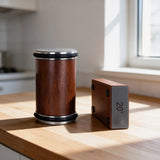
The first route is a fixed-angle tool: a rolling sharpener's magnetic block, a pull-through's slot, or a guided-rod system's constrained arm all hold the blade at one setting. Your hand rolls or strokes; the angle is not yours to manage.
The second route is a whetstone with an angle guide to start each stroke at the right tilt, plus the marker test as a check on whether your hands held it. If you haven't decided which route fits your knives and your time, whether a whetstone is worth it covers both sides.
How much each method leaves to your hand
| Method | What sets the angle | What stays on your hands |
|---|---|---|
| Freehand on a whetstone | Your hands only | Everything: the tilt on every stroke, the pressure, the path heel to tip |
| Angle wedge or clip-on guide on a whetstone | A clip or wedge on the spine rests on the stone and sets the tilt at the start of each stroke | Keeping the guide flat on the stone throughout the stroke; steady pressure and consistent path |
| Guided-rod system | A rod constrained to a set angle; you stroke it along the clamped knife | Even pressure and not rocking the rod off its guide arm |
| Fixed-angle block (rolling sharpener or pull-through) | A magnet or slot holds the blade at the angle, every pass | Rolling direction and light pressure |
Every approach below freehand still needs care. An angle guide tells you where to start each stroke, but it won't stop the blade rocking mid-stroke. A guided-rod system keeps its rod at the angle you set, but pressure and path are still yours. A fixed-angle block removes the question entirely.
The marker test shows whether your strokes stayed at one angle
Color both faces of the bevel with a marker pen before you start, then sharpen as usual. One sharpener maker's FAQ gives the check: when the ink has come off both sides from edge to shoulder, the chosen angle held all the way through. Any ink that remains marks where those strokes hit a different angle.
Use it as a feedback loop, not only a final check. Ink the bevel at the start of a session and make a few passes before committing to the full sharpen. The ink shows whether you are at the right angle before you have taken off much steel.
All three ink patterns are drawn in side view and end-on in how to tell whether your knife has a 15° or 20° edge: clear from edge to shoulder, clear at the very edge only, or clear at the shoulder only. Those same drawings apply whether you are confirming that a new angle held or reading the angle the knife already carries.
What a fixed-angle block sets—and what it does not
A fixed-angle block removes angle inconsistency. The magnet holds the blade flat against the block's face on every pass, so the disc meets the edge at the same angle each time. The block holds the blade at its 15° or 20° face.
What the block is setting is the angle between its face and the disc. Makers quote edge angles from the blade's center line, which is a slightly different measurement. On a blade that tapers from spine to edge, as most kitchen knives do, the two differ by about 1° to 2°. On a blade 1¾ in (45 mm) from edge to spine and approximately 1/16 in (2 mm) thick at the spine, the 15° face produces a bevel of about 13.7° from the center line. That is close enough that most cooks won't notice, but it means the first sharpen on a block is a regrind to the block's angle, not a preservation of whatever angle the knife had before.
What the block does not fix is which angle to pick. Both the 15° face and the 20° face grind a consistent bevel, at different depths, and the choice between them, covered in how to tell whether your knife has a 15° or 20° edge, should be made before the first sharpen.
What helps when sharpening on a whetstone
No whetstone attachment holds the angle the way a block does, but two things narrow how much your hands have to do.
An angle guide. A clip-on or wedge-type guide sits on the spine and rests flat on the stone, setting the blade at a fixed tilt at the start of each stroke. It does not stop the blade from rocking mid-stroke, so you still have to stay steady, but it removes the guesswork about where each stroke begins. Once the right tilt feels familiar, remove the guide and check with the marker test whether your hands are holding it without help.
The spine-height method. The difference between sharpening at 15° and at 20° on a standard 1¾ in chef's knife amounts to roughly ⅛ in of spine height above the stone. Knowing your number before you start gives your hands a specific target. Whether a whetstone is worth it has the calculation and diagram for any blade size.
Once you have the angle, the marker test is the feedback loop. Ink the bevel, make a session's worth of passes, and read the ink. Where it comes off clean from edge to shoulder, the angle held. Where ink remains, those strokes shifted.
Sources

Rollkeen rolling knife sharpener
A magnetic block holds the knife at 15° or 20°. You roll the disc along the edge.
400 grit diamond on one end of the roller, 3000 grit ceramic on the other.
See the sharpener