Angles
What angle are Global knives sharpened at?
Global's US care page gives a range, not a single number — that distinction determines which tool to reach for.
By Rollkeen, which sells a rolling knife sharpener Published
What Global's US distributor states
Global Cutlery USA, the official authorized US distributor of Global knives, publishes a care page with sharpening guidance. That page states the factory edge is sharpened "between 10 and 15 degrees" per side.
That is a five-degree window, not a fixed number. The maker gives a range because different Global models leave the factory at different points within it; there is no single angle that applies to each knife in the lineup.
Yoshikin, the Japanese manufacturer that produces Global, does not publish a sharpening angle in its own English FAQ. The US distributor's care page is the primary source available to customers in the United States.
Why ordinary honing steels do not work for Global knives
The same care page carries a specific warning: do not use an ordinary honing steel on a Global knife. Traditional steels made from other materials are likely to damage Global knives because of their thin edge.
Global's care page recommends ceramic or diamond rods instead. A ceramic rod gives a finer edge if used regularly. A diamond rod brings back a knife edge quicker, making it better suited to a blade that has gone noticeably dull.
A blade that has been maintained with one of these traditional steels may carry more damage, so expect the first sharpening to take longer than it would on a well-maintained knife.
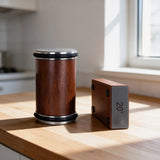
Which end of a 15°/20° rolling sharpener to use
A rolling sharpener with a 15° face and a 20° face has two distinct positions. Global double-bevel knives belong on the 15° face.
The arithmetic makes the choice clear: Global's range runs from 10° to 15° per side. The 15° face sits at the wide end of that window. Using the 20° face would set the edge steeper than the maker intends, working against the thin acute geometry that Global's design relies on.
If the knife's factory grind is closer to 10° (the narrow end of Global's range), the first pass on the 15° face removes a small amount of metal to blend the two angles. That is expected on the first sharpening session. After that, subsequent sessions will be quick because the edge already sits at 15°.
On Rollkeen's rolling sharpener, use the 15° face for Global double-bevel knives. For a side-by-side comparison of what angle other brands specify, the knife sharpening angle chart covers the full list in one table.
Single-bevel Global models are a different case
Not every Global knife has a double-bevel edge. The IST-05 deba and the IST-06 yanagi are single-bevel: one face is entirely flat, and the other face carries the full bevel. A fixed-angle rolling sharpener cannot handle these correctly; they require a whetstone and hand sharpening.
Chef's knives, santokus, and utility knives are the Global models most home cooks reach for; all are double-bevel and suited to a fixed-angle approach. If you are unsure about a specific knife, check each face with a fingertip: on a double-bevel knife, both faces taper from spine to edge; on a single-bevel knife, one face is flat all the way to the edge.
For a fuller treatment of Japanese knife geometry and the per-side vs. total angle convention, which makes Global's figures sometimes read differently than expected, the Japanese knife sharpening angle guide walks through both conventions in full.
Measured angles from independent equipment reviews
America's Test Kitchen has measured several Global knives as part of equipment reviews. These figures are ATK's measurements, not Global's published specification.
- G-48 Santoku: 15° per side (ATK, 2017)
- Classic 3.5" Paring Knife: 10–15° per side (ATK, 2025)
- Roast Slicer: 15° per side (ATK, 2025)
- G-12 Meat Cleaver: 15° per side (ATK, 2026)
- G-21 6.25" Flexible Boning Knife: 15° per side (ATK, 2026)
All five measurements fall at or within Global's stated 10–15° per side range. Four of the five sit at 15°, and the fifth matches Global's full range.
What to confirm before you start
A diamond-and-ceramic rolling sharpener works on steel blades. Run a refrigerator magnet along the flat of the blade first: if it holds firmly, the steel is magnetic and suited to this method. If the magnet slides off without gripping, the knife is not a candidate for a fixed-angle rolling sharpener.
A fixed-angle rolling sharpener is not suitable for serrated Global blades, ceramic blades, the IST-05 deba, or the IST-06 yanagi.
The abrasive wheels on Rollkeen's sharpener run dry: no water or oil needed, with 400-grit diamond on the first stage and 3000-grit ceramic on the second.
Shun's FAQ gives 16° per side for its double-bevel knives, putting it close to the 15° face as well; the Shun knife sharpening angle page documents the maker's figure and covers the same face-selection decision.
Sources
- Global Cutlery USA: knife care
- America's Test Kitchen: santoku knives review (25 September 2017)
- America's Test Kitchen: paring knives review (3 September 2025)
- America's Test Kitchen: slicing knives review (9 July 2025)
- America's Test Kitchen: cleavers review (29 April 2026)
- America's Test Kitchen: flexible boning knives review (1 April 2026)

Rollkeen rolling knife sharpener
A magnetic block holds the knife at 15° or 20°. You roll the disc along the edge.
400 grit diamond on one end of the roller, 3000 grit ceramic on the other.
See the sharpener