Angles
What angle are Cutco knives sharpened at?
Cutco's 2017 article gives 'a 15 degree angle' for its straight-edge knives — side or total not stated. Its Double-D edge, the scalloped style found on many Cutco models, cannot be sharpened at home and must go back to Cutco's factory.
By Rollkeen, which sells a rolling knife sharpener Published
Cutco gives “a 15 degree angle” for its straight-edge knives
A 2017 article on Cutco’s own site gives the sharpening angle for straight-edge knives as “a 15 degree angle.” Cutco does not say whether this is per side or the total edge, and the article predates more recent production: treat it as the most specific public figure available, not a confirmed current specification.
Not every Cutco knife has a straight edge. Many Cutco models carry the company’s Double-D edge, a recessed scalloped style that cannot be sharpened at home with any device. Cutco’s product care page sends every Double-D knife back to the factory. Check which edge your knife has before choosing a sharpener. For how knife makers’ angles compare across brands, the knife sharpening angle chart covers more than 30 makers.
Is your Cutco knife a straight edge or a Double-D?
Hold the blade tip toward a light and look down the actual cutting edge, not the flat side of the blade. A straight edge is smooth along its whole length. A Double-D edge shows a row of small scallops from heel to tip, easy to see in decent light even without magnification.
If the edge is smooth, the knife can be sharpened at home; which knives fit a rolling sharpener covers whether a particular device will hold it. If you see scallops, the knife goes to Cutco’s factory, not to a sharpening block.
The Double-D edge must go back to Cutco’s factory
The Double-D is a type of serrated edge. Cutco’s product care page is direct: it must not be sharpened at home with any sharpener, because doing so ruins it. Rolling sharpeners, Rollkeen’s included, are not for serrated edges. Straight-edge Cutco knives, by contrast, can be sharpened at home.
Cutco’s factory sharpening service takes every Cutco knife, straight-edge and Double-D alike. Sharpening is free under Cutco’s Forever Guarantee; the owner pays shipping both ways, with a return shipping fee.
The 15° face is the right choice for a straight-edge Cutco knife
Whether Cutco’s “a 15 degree angle” is per side or total, the 15° face of Rollkeen’s angle block is the nearer of the two. The first sharpening sets the edge to the block’s angle; maintaining it after that takes a few minutes about every two weeks for a knife you use daily.
Confirm the knife fits the sharpener first: see which knives can a rolling knife sharpener sharpen for the size and magnet checks.
Full-size Cutco chef’s knives and similar long blades fit the sharpener. Short blades, Cutco’s paring and steak knives among them, are too short to reach the disc. See which knives fit a rolling sharpener for the full size checks.
The marker test shows which end of the block matches a knife that may already have been sharpened at a different angle, useful before the first time you sharpen a particular Cutco knife.
Sources

Rollkeen rolling knife sharpener
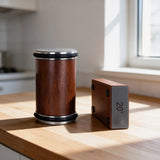
A magnetic block holds the knife at 15° or 20°. You roll the disc along the edge.
400 grit diamond on one end of the roller, 3000 grit ceramic on the other.
See the sharpener